

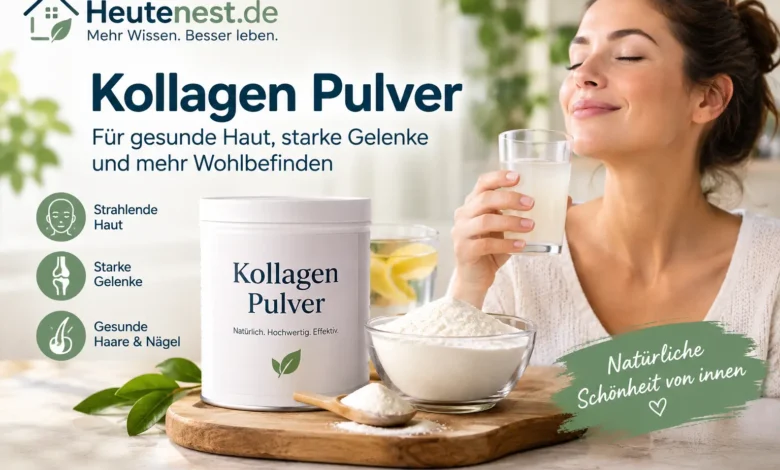
Kollagen Pulver has become a popular ingredient in the world of nutrition and beauty supplements. It is commonly mixed into water, coffee, smoothies or yoghurt and is marketed for areas such as skin, joints, connective tissue and general protein intake. But what exactly happens after taking it, which forms are available, and what does current scientific evidence actually say?
This guide takes a closer look at Kollagen Pulver from A to Z. Instead of simply repeating advertising promises, it explains collagen, hydrolysed collagen, collagen peptides, collagen types, sources, dosage, vitamin C, quality criteria, possible side effects and the differences between common product formats.
The aim is simple: even if you have never used a collagen supplement before, you should understand what you are buying, how it is normally used and which claims deserve a closer look.
Kollagen Pulver 2026: Wirkung, Einnahme und Kaufberatung
Collagen is a structural protein naturally found throughout the human body. It contributes to the structure of tissues such as skin, bones, cartilage, tendons and connective tissue.
Commercial collagen supplements are generally made from animal-derived raw materials and are usually processed into collagen hydrolysate or collagen peptides. The resulting powder is designed to be easy to mix and digest.
However, there is an important distinction between what collagen does naturally in the body and what taking a collagen supplement has been proven to achieve.
The body does not simply send swallowed collagen directly to the skin or joints. During digestion, proteins are broken down into smaller peptides and amino acids. These building blocks enter normal protein metabolism, where the body uses them according to its physiological needs.
Current evidence therefore needs to be separated from marketing claims. A 2025 systematic review and meta-analysis of 23 randomized controlled trials found that higher-quality and independently funded studies did not show a significant improvement in skin hydration, elasticity or wrinkles.
That does not mean collagen has no biological role. It means that the assumption that consuming collagen automatically produces a visible cosmetic or therapeutic effect is much stronger than the current evidence supports.
Was ist Kollagen und wie wird es gewonnen?
Kollagen is a family of structural proteins. It is particularly important in tissues where strength, flexibility and structural support are required.
The human body produces collagen itself from amino acids. Nutrients such as vitamin C are also involved in normal collagen formation.
Commercial collagen is different. It is obtained from animal tissues containing collagen. Depending on the product, raw materials can come from cattle, pigs, fish or poultry.
Common sources include:
- bovine hides and other collagen-rich tissues
- porcine skin
- fish skin and scales
- poultry-derived collagen-rich tissues
- other animal connective tissues
The raw material is cleaned and processed before the collagen is extracted. For most modern supplements, the protein is then hydrolysed.
Hydrolysis means that large protein structures are broken down into smaller peptide chains. This makes the material more suitable for use in a water-soluble supplement.
The final powder may therefore contain collagen peptides rather than intact collagen fibres.
Kollagenhydrolysat und Kollagenpeptide erklärt
The terms Kollagenhydrolysat, hydrolysed collagen and Kollagenpeptide are closely related but describe different aspects of the same processing concept.
Collagen hydrolysate is collagen that has been enzymatically or otherwise hydrolysed into smaller fragments. These fragments are called collagen peptides.
Why is this important?
Intact collagen is a large structural protein. It is not simply absorbed as an intact fibre after consumption. Digestion breaks proteins down before their components can be absorbed.
Hydrolysed products are therefore commonly used in supplements because the resulting peptides are easier to dissolve and digest.
A typical process looks like this:
- collagen-rich animal material is selected
- the material is cleaned and processed
- collagen is extracted
- the protein is hydrolysed
- larger protein structures are divided into smaller peptides
- the material is purified and dried
- the finished powder is packaged
The exact processing method and raw material quality can vary between manufacturers.
Another term sometimes found on labels is peptide molecular weight, often expressed in Dalton. A lower average molecular weight generally means that the collagen has been processed into smaller peptides. However, a smaller number alone does not automatically prove that a product will deliver a particular health or cosmetic benefit.
Kollagen Typ I, Typ II und Typ III im Vergleich
Collagen is not one single protein type. Different collagen types occur in different tissues.
Kollagen Typ I
Type I is the most abundant collagen type in the human body. It is particularly associated with:
- skin
- bones
- tendons
- ligaments
- connective tissue
It is also commonly found in bovine and marine collagen products.
Kollagen Typ II
Type II is particularly associated with cartilage. Because of this, it frequently appears in products marketed around joint nutrition.
It is important, however, not to turn the presence of Type II collagen into an automatic claim that a supplement treats joint disease.
Kollagen Typ III
Type III is found alongside Type I in several connective tissues and is associated with structures such as skin, blood vessels and internal connective tissue.
Many collagen products contain predominantly Type I and/or Type III collagen, depending on their source.
Why do collagen types matter?
The type can tell you something about the source and intended composition of a product, but it should not be treated as a guarantee of a particular outcome.
A useful approach is to look at the complete label:
- collagen source
- collagen type
- amount per serving
- whether the product contains hydrolysed peptides
- additional ingredients
- testing and quality information
Rinderkollagen oder Fischkollagen?
Two frequently discussed sources are bovine collagen and marine collagen.
Rinderkollagen is usually obtained from cattle-derived collagen-rich material. It commonly contains Type I collagen and may also contain Type III collagen.
Fischkollagen, often called marine collagen, is generally obtained from fish skin, scales or other collagen-containing parts.
The differences are mainly related to:
| Aspect | Bovine collagen | Marine collagen |
|---|---|---|
| Source | Cattle | Fish |
| Common types | Type I, often Type III | Mainly Type I |
| Animal origin | Mammalian | Aquatic |
| Important consideration | Origin and processing | Fish species and allergen considerations |
| Suitable for vegans | No | No |
Is fish collagen automatically better?
No. Source alone does not establish overall product quality or effectiveness. Transparency, purity, processing, dosage, testing and the complete formulation also matter.
People with fish allergies should pay particular attention to the source.
Wie wirkt Kollagen im Körper?
The body does not treat consumed collagen as a finished piece of skin, cartilage or tendon.
After consumption, digestive enzymes break the protein down into smaller peptides and amino acids. These components are absorbed and enter the body’s normal amino acid and protein metabolism.
Important amino acids associated with collagen include:
- glycine
- proline
- hydroxyproline
These amino acids are part of collagen’s characteristic structure.
The key point is that the body controls how absorbed amino acids and peptides are used. They are not delivered exclusively to the skin simply because the supplement was marketed for skin.
This distinction explains why the phrase “eat collagen and it goes directly to your wrinkles” is an oversimplification.
The body continuously produces, breaks down and rebuilds proteins. Nutrition provides the raw materials, but individual tissues regulate their own biological processes.
Kollagen Pulver für die Haut
Skin is one of the body’s major collagen-containing tissues, which is why collagen supplements are heavily marketed for beauty purposes.
Typical marketing claims include:
- smoother-looking skin
- improved elasticity
- increased hydration
- fewer visible wrinkles
- younger-looking skin
But these claims must be separated from established scientific evidence.
A 2025 meta-analysis of randomized controlled trials found that the apparent positive results became much less convincing when study quality and funding were considered. Higher-quality and non-industry-funded studies did not show significant benefits for skin hydration, elasticity or wrinkles.
This is an important lesson for consumers: a product can have several positive individual studies without the overall evidence being strong enough to establish a reliable cosmetic effect.
Kollagen und Hautelastizität: Was sagt die Wissenschaft?
Skin elasticity depends on a complex network of collagen, elastin, water content, extracellular matrix components and other biological factors.
Ageing changes this network, while factors such as ultraviolet radiation, smoking and general lifestyle also influence skin ageing.
It would therefore be misleading to attribute visible skin ageing to collagen alone.
The current evidence around oral collagen supplementation is mixed. Some individual studies have reported improvements in measurements such as skin hydration or elasticity, but systematic evaluations have raised concerns about study quality, small sample sizes and industry funding.
Stiftung Warentest reported that its review of 23 randomized controlled trials found no significant benefit in high-quality and independently funded studies for hydration, elasticity or wrinkles.
This means the most accurate conclusion is not “collagen definitely works” or “collagen definitely does nothing.” Instead, the evidence for a clinically meaningful anti-ageing effect remains insufficient.
There is also a legal aspect in Germany and the EU. Health-related claims made for foods and supplements are regulated. Verbraucherzentrale notes that health claims specifically attributing improved skin structure or joint health to collagen have not been authorised on the basis of sufficient scientific evidence.
Kollagen für Haare, Nägel und Bindegewebe
Collagen supplements are also promoted for hair and nails.
Hair itself is primarily made from keratin rather than collagen. Nails are also primarily composed of keratin.
That distinction matters.
Collagen peptides provide amino acids, but this does not mean that consuming collagen automatically causes faster hair growth or stronger nails.
The same applies to connective tissue. Collagen is unquestionably an important structural protein in connective tissue, but the biological role of collagen in the body should not be confused with proof that an oral supplement improves connective tissue in healthy people.
A balanced diet already provides protein and amino acids from many sources.
Kollagen Pulver für Gelenke und Knorpel
Joint health is another major reason people consider collagen supplements.
Cartilage contains collagen, particularly Type II collagen, and connective tissues around joints also contain structural proteins.
This has led to interest in collagen hydrolysate and collagen peptides for joint comfort.
But a supplement should not be confused with a treatment for osteoarthritis.
The Verbraucherzentrale’s July 2026 information states that there is not sufficient reliable scientific evidence for a general therapeutic benefit of collagen hydrolysate in people with knee osteoarthritis. It also notes that collagen hydrolysate is not included in the current guideline-based treatment approach for knee osteoarthritis.
If someone has persistent knee pain, swelling, restricted movement or another joint problem, the correct step is medical assessment rather than relying on a supplement.
Kollagen für Knochen, Sehnen und Muskeln
Collagen is naturally present in bones and tendons, so these tissues are often mentioned in discussions about collagen nutrition.
However, biological presence does not automatically mean that supplementation produces a measurable benefit.
Bone health depends on a much broader system involving:
- calcium
- vitamin D
- phosphorus
- protein
- physical activity
- hormonal factors
- age
- overall nutrition
Tendons are also complex tissues that respond to mechanical loading, training and recovery.
Muscle is different again. Collagen is not equivalent to a complete muscle-building protein source. It has a different amino acid profile and is relatively low in some essential amino acids important for stimulating muscle protein synthesis.
For people focused on muscle growth, overall protein intake and an appropriate resistance-training programme are more important than treating collagen as a conventional sports protein.
Was sagen aktuelle Studien zu Kollagen?
Scientific evidence should always be considered as a whole rather than by selecting the most positive individual study.
Several collagen studies have reported potential improvements in areas such as skin hydration, elasticity or joint-related outcomes. At the same time, systematic reviews have identified limitations including:
- small sample sizes
- short intervention periods
- different collagen formulations
- different dosages
- different outcome measurements
- industry funding
- methodological differences
The 2025 meta-analysis discussed by Stiftung Warentest is particularly relevant because it examined 23 randomized controlled trials involving around 1,500 participants. Its results showed that positive findings were not maintained in the higher-quality and independently funded studies.
That is why evidence-based writing should distinguish between possible effects, observed effects in individual studies and clinically established benefits.
Wissenschaftliche Evidenz vs. Werbeversprechen
A useful way to evaluate collagen marketing is to ask three questions:
What is biologically plausible?
Collagen is unquestionably an important structural protein in the human body.
What has been observed in studies?
Some trials have reported measurable changes in certain outcomes.
What is firmly established for everyday consumers?
The evidence is not strong enough to support broad promises that oral collagen supplementation reliably reverses skin ageing or treats joint disease.
The distinction is particularly important because EU food law places restrictions on health claims.
For example, Verbraucherzentrale explains that claims suggesting collagen makes skin firmer, smoother or younger can fall under regulated health claims and may not be used freely when they lack the required authorisation.
Vitamin and mineral claims are a different matter. Certain authorised claims exist for nutrients such as vitamin C, zinc or biotin when the relevant conditions are met. But an authorised nutrient claim should not be interpreted as proof that the entire collagen product produces the same effect.
Kollagen Pulver richtig einnehmen
Most collagen supplements are supplied as a powder that is mixed with a liquid or soft food.
Common options include:
- water
- coffee
- tea
- smoothies
- yoghurt
- plant-based yoghurt alternatives
- porridge
Hydrolysed collagen is generally designed to dissolve more easily than intact collagen.
The most important practical factor is following the manufacturer’s serving instructions rather than assuming that a larger amount is automatically better.
It is also useful to check whether the product contains additional sweeteners, flavours, vitamins, minerals or other ingredients.
Wann sollte man Kollagen einnehmen?
Morning, afternoon and evening are all commonly used.
There is currently no well-established scientific reason that requires everyone to take collagen at a specific time of day.
If taking it with breakfast makes it easier to remember, that can be a practical choice. Someone else may prefer mixing it into an evening drink.
Consistency is therefore more relevant from a routine perspective than trying to find a special “best” hour.
If the product label gives specific instructions, those instructions should be followed.
Wie viel Kollagen sollte man täglich nehmen?
There is no universally established official daily requirement for collagen hydrolysate.
Commercial products commonly suggest amounts in the range of a few grams up to around 10 grams per day. CHIP’s 2026 testing article notes that 2.5 to 10 grams are common serving amounts and stresses that these are not an official government-established daily requirement.
More is not automatically better.
Before increasing the amount, consider:
- the manufacturer’s serving recommendation
- the actual collagen content
- the rest of the daily diet
- total protein intake
- other supplements being taken
- individual tolerability
The BfR information cited by Stiftung Warentest indicates that there were no health concerns regarding additional intake of up to 5,000 mg collagen per daily intake of a product, but this should not be interpreted as an effectiveness target or as an individually appropriate dose.
Kollagen Pulver mit Vitamin C
Vitamin C has a well-established physiological role in normal collagen formation.
This is one reason many collagen supplements contain added vitamin C.
But there is an important distinction:
Vitamin C supports normal collagen formation in the body.
That does not mean that adding large quantities of vitamin C to a collagen supplement automatically makes the product more effective for wrinkles or joint problems.
If your normal diet already provides enough vitamin C, you may not need a high-dose supplement.
Good dietary sources include:
- peppers
- citrus fruits
- berries
- broccoli
- cabbage
- kiwi
- other fruits and vegetables
A product containing vitamin C may be convenient, but the presence of vitamin C should not be used as proof that the collagen itself has a clinically proven cosmetic effect.
Wie lange dauert es, bis Kollagen Wirkung zeigt?
There is no scientifically established universal timeframe after which everyone should expect a visible collagen effect.
Some commercial products suggest several weeks or months, while individual studies often use intervention periods lasting weeks or months.
However, a timeframe printed on a package is not proof that a visible result will occur after that period.
If someone notices a change after using a supplement, other factors can also contribute, including:
- hydration
- seasonal changes
- skincare
- diet
- sleep
- weight changes
- exercise
- natural variation in skin appearance
This is why personal experience should be treated as personal experience rather than clinical evidence.
Kollagen Pulver Test 2026: Darauf kommt es an
A useful product comparison should evaluate more than packaging and marketing language.
CHIP’s 2026 test illustrates this approach by comparing factors including collagen quantity, protein content, additives, number of servings, price per daily dose, collagen types, transparency, source information, laboratory testing, solubility and taste.
For consumers, the following test criteria are particularly useful:
- actual collagen content
- source of the collagen
- collagen type
- degree of transparency
- ingredient list
- additional substances
- quality controls
- laboratory testing
- price per meaningful serving
- solubility
- taste
- packaging information
A product that looks inexpensive per package can become expensive if it contains a small number of servings.
Comparing price per serving or price per 10 grams of collagen is usually more meaningful than comparing package prices.
Die wichtigsten Kaufkriterien
Before buying a collagen supplement, start with the label rather than the advertising slogan.
Look for:
- clearly stated collagen source
- clear collagen amount per serving
- collagen type where relevant
- hydrolysed collagen or peptide information
- complete ingredient declaration
- sensible serving size
- manufacturer information
- batch or quality information where available
- transparent testing information
- understandable allergen information
A long ingredient list is not automatically bad, and a short ingredient list is not automatically better.
The goal is transparency.
Lesen Sie unseren aktuellen und genauen Ratgeber zum Thema König der Löwen Hamburg.
Qualität von Kollagen Pulver erkennen
Quality cannot be determined by the word “premium” on a package.
A more useful assessment asks whether the manufacturer provides meaningful information about:
Raw material: Where does the collagen come from?
Processing: Is it hydrolysed and how is it processed?
Purity: Are there meaningful quality-control or laboratory details?
Transparency: Does the manufacturer clearly disclose what the product contains?
Dosage: How much collagen does one serving actually provide?
Additives: Are sweeteners, flavourings or other ingredients included?
Traceability: Can the origin and production information be understood?
A transparent product makes these questions easier to answer.
Kollagenmenge und Dosierung pro Portion
Two products can both contain “collagen” while delivering very different amounts per serving.
For example, one serving may contain 2.5 grams of collagen while another contains 10 grams.
This is why the front of the package should not be the only source of information.
Check the nutrition or ingredient declaration and identify:
- serving size
- collagen amount per serving
- number of servings
- additional protein
- added nutrients
If a product claims to contain 10 grams of collagen but the recommended serving requires two scoops, compare that with products where the serving size is different.
Standardising the comparison makes shopping easier.
Reinheit, Zusatzstoffe und Inhaltsstoffe
Pure collagen products may contain very little beyond collagen peptides.
Other products may include:
- vitamin C
- zinc
- biotin
- hyaluronic acid
- flavourings
- sweeteners
- acids
- minerals
- plant extracts
None of these ingredients automatically determines whether a product is good or bad.
Instead, ask whether each additional ingredient has a clear purpose and whether you actually want it.
For people with allergies or intolerances, the complete ingredient and allergen information becomes particularly important.
Herkunft und Herstellung
Origin can matter for consumers who want to understand where their collagen comes from.
A product may specify:
- bovine source
- marine source
- porcine source
- poultry source
- country of origin
- production location
- farming or husbandry information
However, “European”, “premium” or “natural” should not automatically be treated as a quality guarantee.
Look for specific information rather than vague promotional terminology.
Löslichkeit und Geschmack im Alltag
A supplement can have an impressive label and still be inconvenient to use.
Hydrolysed collagen is generally intended to be easy to dissolve, but products can differ considerably in:
- taste
- smell
- texture
- cloudiness
- mixing behaviour
- aftertaste
CHIP’s 2026 practical comparison tested products under similar conditions, including dissolving 10 grams in 200 ml of cold water and evaluating taste, solubility and surface residue.
This is a useful reminder that everyday usability is a legitimate buying criterion.
If you plan to take a product daily, a powder you actually enjoy using is more practical than one you dislike but bought solely because of its marketing.
Preis-Leistungs-Verhältnis richtig vergleichen
The cheapest package is not necessarily the cheapest product.
Calculate:
Package price ÷ number of servings = approximate cost per serving.
You can also compare the cost of a standard amount of collagen, such as 10 grams, where the label provides enough information.
Consider:
- collagen per serving
- number of servings
- price
- source
- purity
- testing
- additional ingredients
- serving size
Stiftung Warentest reported that regular collagen supplement use can cost roughly €20 to €40 per month depending on the product, illustrating why cost per daily serving matters.
Kollagen Pulver Erfahrungen: Was Nutzer berichten
Personal experiences can be useful for understanding how convenient a product is.
People may report:
- better taste than expected
- difficulty mixing the powder
- an unusual smell
- easier integration into coffee
- changes they believe they noticed in their skin
- changes in perceived joint comfort
But testimonials cannot establish cause and effect.
If someone says, “My skin looked better after six weeks,” several explanations are possible. The person may genuinely have noticed a change, but that does not prove the collagen caused it.
Anecdotes are therefore best used as information about experience, not as scientific evidence of effectiveness.
Kollagen Pulver Nebenwirkungen und Verträglichkeit
Collagen supplements are generally consumed as food supplements rather than medicines, but “food supplement” does not mean that every person will tolerate every formulation identically.
Possible issues can include:
- digestive discomfort
- unpleasant taste or smell
- intolerance to additional ingredients
- allergic reactions related to the source
- problems caused by sweeteners or flavourings
The ingredient list matters as much as the collagen itself.
A person who reacts to fish, for example, should pay particular attention to marine collagen.
Persistent or serious symptoms should not be ignored.
Allergien und mögliche Unverträglichkeiten
The collagen source is especially important for people with allergies.
Marine collagen can be relevant for people with fish allergies.
Other products may contain additional allergens or ingredients that cause intolerance.
Always check:
- source animal
- allergen declaration
- additional ingredients
- flavourings
- sweeteners
- other supplements taken at the same time
If you have a diagnosed allergy or a history of significant reactions, professional advice is more appropriate than experimenting with multiple supplements.
Kollagen in Schwangerschaft und Stillzeit
Pregnancy and breastfeeding require additional caution with supplements because safety data are not always available for every ingredient and formulation.
CHIP notes that controlled safety studies for collagen supplementation during pregnancy are lacking and recommends discussing supplementation with a doctor.
The same principle applies during breastfeeding.
A collagen supplement should therefore not be treated as automatically necessary simply because it is sold as a food supplement.
Ist Kollagen für Vegetarier und Veganer geeignet?
True collagen is animal-derived.
There is currently no conventional plant-based collagen that is identical to animal collagen.
Products marketed as “vegan collagen” generally contain nutrients or amino acids intended to support the body’s own collagen production rather than providing actual collagen protein.
This distinction should be visible on the product label.
A vegan product may contain ingredients such as vitamin C, zinc, copper or plant-derived nutrients, but that does not make the product itself a source of collagen.
Kollagen Pulver oder Kapseln?
Powder and capsules are simply different delivery formats.
Powder
Advantages can include:
- larger collagen quantities per serving
- flexible serving size
- easy mixing into drinks or food
- often fewer capsules required
Potential disadvantages:
- must be mixed
- taste may be noticeable
- measuring can be inconvenient
Capsules
Advantages can include:
- convenient
- no mixing
- easy to carry
- no taste from powder
Potential disadvantages:
- several capsules may be required for a larger collagen amount
- potentially higher cost per serving
- less flexibility in adjusting the amount
The better format therefore depends mainly on personal preference and the actual amount of collagen provided.
Kollagen Pulver oder Trinkampullen?
Liquid collagen products are marketed as convenient ready-to-drink alternatives.
They can also contain:
- sweeteners
- flavourings
- preservatives
- vitamins
- minerals
- other active ingredients
Powder generally gives consumers more control over how much they mix and what they combine it with.
The important comparison is not “powder versus drink” in isolation. Look at the complete formulation, collagen quantity, serving cost and additional ingredients.
Natürliches Kollagen und Nahrungsergänzung im Vergleich
The word “natural” can be confusing.
The body naturally produces collagen.
Foods also naturally contain proteins and amino acids that contribute to the body’s overall protein supply.
A collagen supplement, on the other hand, is a concentrated processed product.
A balanced diet can provide protein from:
- fish
- eggs
- dairy products
- meat
- legumes
- soy
- grains
- nuts and seeds
Vitamin C can be obtained from many fruits and vegetables.
For most healthy people, supplementation should therefore be viewed as an optional nutritional product rather than a replacement for a balanced diet.
Häufige Fehler beim Kauf von Kollagen
Several mistakes can make collagen shopping more confusing than it needs to be.
Only looking at the package price:
Always calculate the price per serving.
Choosing based on “premium” wording:
Marketing terminology does not replace transparent product information.
Assuming more collagen means more benefit:
There is no simple rule that more automatically produces better results.
Ignoring the source:
Fish, bovine and other sources have different implications.
Confusing biological role with proven supplement effect:
The body needs collagen, but that does not automatically establish that supplementation improves a particular symptom.
Treating testimonials as evidence:
Personal experiences cannot replace controlled studies.
Ignoring additives:
The collagen may not be the only ingredient.
Assuming vegan collagen is actual collagen:
Most vegan collagen products provide nutrients intended to support normal collagen production rather than collagen itself.
Believing a product can treat disease:
Food supplements are not substitutes for medical treatment.
Häufige Fragen
Was bringt Kollagen Pulver wirklich?
Collagen is an important structural protein, but the benefits of oral collagen supplementation should not be overstated. Current evidence does not establish a reliable anti-ageing effect on skin, and there is insufficient evidence to regard collagen hydrolysate as a proven treatment for knee osteoarthritis.
Ist die tägliche Einnahme sinnvoll?
Whether daily use makes sense depends on the individual’s goals, diet, product and expectations. There is no universally established daily collagen requirement for healthy people. If someone chooses to use a supplement, following the manufacturer’s serving instructions is more sensible than automatically taking a larger amount.
Welches Kollagen ist für die Haut geeignet?
Type I collagen is particularly abundant in human skin, but the presence of Type I in a supplement does not prove that the product will visibly improve the skin. The current clinical evidence for oral collagen supplements and skin ageing remains mixed and insufficient for broad anti-ageing promises.
Welches Kollagen ist für Gelenke geeignet?
Type II collagen is strongly associated with cartilage, while hydrolysed collagen products can contain different collagen types. However, the collagen type alone does not establish that a product treats joint disease. For knee osteoarthritis, current German consumer guidance considers the evidence insufficient for a general therapeutic benefit from collagen hydrolysate.
Ist Fischkollagen besser als Rinderkollagen?
Neither source can simply be called universally better. Marine collagen is commonly associated with Type I collagen, while bovine products commonly contain Type I and sometimes Type III. Source, purity, dosage, transparency and individual dietary requirements should all be considered.
Wie viel Kollagen ist pro Tag sinnvoll?
Commercial products commonly recommend several grams per day, often around 2.5 to 10 grams. These amounts should not be confused with an officially established daily requirement. CHIP reports this range as common in commercial use while noting the lack of an official daily recommendation.
Kann man Kollagen dauerhaft einnehmen?
There is no universal rule that everyone should take collagen indefinitely. Long-term use should be considered in the context of the product, overall diet, individual needs and the reason for supplementation. Taking more for longer is not automatically more beneficial.
Kann Kollagen Pulver Nebenwirkungen verursachen?
Some people may experience digestive discomfort, unpleasant taste or intolerance to specific ingredients. Allergic reactions are particularly relevant when the product contains a source to which someone is sensitive, such as fish. Checking the complete ingredient and allergen information is therefore important.
Ist Kollagen Pulver mit Vitamin C sinnvoll?
Vitamin C contributes to normal collagen formation, which explains why it is often included in collagen supplements. However, adding vitamin C does not prove that the collagen product will produce a cosmetic or therapeutic benefit. The nutritional role of vitamin C and the evidence for collagen supplementation should be considered separately.
Worauf sollte man beim Kauf 2026 achten?
Focus on transparent information rather than advertising claims. Check the collagen source, amount per serving, collagen type, ingredient list, additional substances, quality information, testing details, number of servings and price per serving. A transparent label makes meaningful comparisons much easier.
FAQs
Is collagen powder a protein?
Yes. Collagen is a structural protein. Collagen supplements provide collagen-derived peptides and amino acids.
Does collagen powder contain complete protein?
Collagen has a different amino acid profile from many conventional dietary proteins and is not generally considered a complete protein source in the same way as high-quality dietary proteins containing all essential amino acids in useful proportions.
Can collagen powder replace protein powder?
Not automatically. Collagen and conventional protein powders serve different nutritional purposes. People looking for a broad protein source should consider the complete amino acid profile of their diet.
Can collagen be mixed with hot drinks?
Many collagen powders are designed to be mixed into beverages such as coffee or tea. Always follow the manufacturer’s instructions regarding preparation.
Does collagen powder contain animal ingredients?
Conventional collagen is animal-derived. The source may be cattle, fish, pigs or poultry depending on the product.
Is marine collagen suitable for people with fish allergies?
People with fish allergies should not assume that marine collagen is suitable. The source and allergen information should be checked carefully.
Is vegan collagen real collagen?
Conventional collagen is animal-derived. Products described as vegan collagen generally provide nutrients or amino acids intended to support the body’s own collagen production rather than containing animal collagen.
Does collagen powder help with wrinkles?
Current evidence does not establish a reliable clinically meaningful anti-ageing effect. A 2025 meta-analysis found no significant benefit in higher-quality and independently funded studies for skin hydration, elasticity or wrinkles.
Can collagen powder cure joint problems?
No. Food supplements should not be treated as medicines. Current German consumer guidance states that there is insufficient evidence for a general therapeutic benefit of collagen hydrolysate in knee osteoarthritis.
Is collagen powder necessary for healthy people?
There is no established requirement for healthy people to consume collagen supplements. The body produces collagen itself and obtains amino acids and relevant nutrients through normal nutrition.
Conclusion
Collagen is an important structural protein with a genuine biological role in skin, connective tissue, bones, cartilage and other tissues. That fact explains why collagen supplements attract so much attention.
But the science behind supplementation is more nuanced than many advertisements suggest.
Hydrolysed collagen and collagen peptides provide protein-derived building blocks, but the body does not simply direct them to one chosen tissue. Current research on cosmetic and joint-related benefits remains mixed, and higher-quality evidence has not confirmed many of the broad claims commonly associated with collagen supplements.
For consumers, the most useful approach is therefore to look beyond the marketing label. Check the source, collagen amount, ingredients, processing, quality information, testing, serving size and real cost per serving.
Most importantly, distinguish between what collagen naturally does in the human body, what a particular product contains, and what clinical research has actually demonstrated.
Lesen Sie unseren aktuellen und genauen Ratgeber zum Thema Osterferien Hessen.