

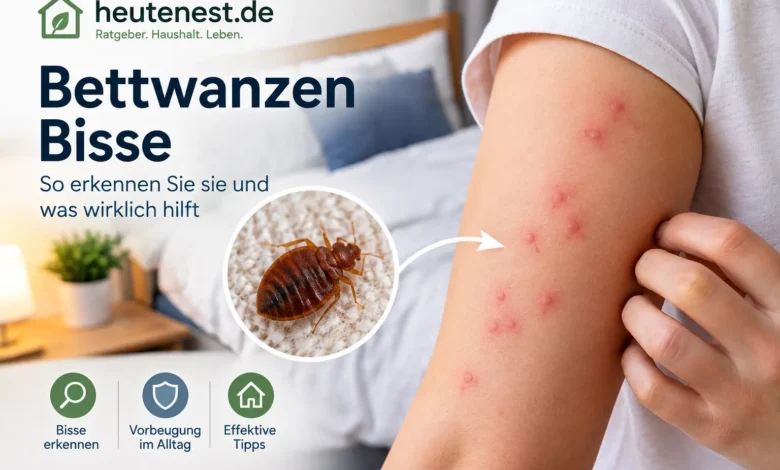
Bettwanzen Bisse can be alarming, especially when several itchy red marks suddenly appear after sleeping. The important thing to understand is that the skin reaction alone does not prove a bed bug infestation. Bettwanzen Bisse can look similar to mosquito bites, flea bites, allergic reactions and other skin conditions, so the surrounding evidence matters just as much as the marks themselves.
This guide explains everything you need to know in simple language: how to recognize the typical skin reaction, where marks commonly appear, how to distinguish them from other insect bites, what can relieve itching, when medical advice is appropriate, how to identify an infestation in the bedroom, and what to do with bedding, clothes, luggage and other belongings. The information reflects current guidance available in 2026, including the latest information from the German Umweltbundesamt.
Bettwanzen Bisse: Wie sehen sie aus und woran erkennt man sie?
Bed bug bites are skin reactions caused when bed bugs feed on blood, usually while a person is sleeping. The insects are mainly active at night and can bite exposed areas of skin.
Typical signs may include:
- Small red or swollen spots
- Itchy areas of skin
- Several marks close together
- Marks that appear in a line or cluster
- Reactions on exposed skin after sleeping
- Itching that may start immediately or only after some time
- In some people, almost no visible reaction at all
One important point is often overlooked: not everyone reacts to a bite in the same way. Some people develop obvious red, itchy areas, while others may have very mild symptoms or no visible skin reaction. The appearance of the skin therefore cannot reliably identify the insect on its own.
A particularly recognizable pattern is sometimes called a Wanzenstraße, meaning several marks positioned close together or roughly in a line. However, this pattern is not a guaranteed diagnostic sign. Other insect bites can also appear in groups or lines.
The most reliable confirmation comes from finding the actual insect, nymphs or characteristic infestation evidence near the sleeping area.
Typische Symptome und Hautreaktionen
The reaction can range from a tiny red point to a larger, itchy, swollen area.
Common symptoms include:
- Redness
- Itching
- Small raised bumps
- Local swelling
- Several affected areas
- Irritated or scratched skin
- Disturbed sleep because of persistent itching
Some people notice the marks when they wake up, while others only notice them later. A delayed reaction does not automatically mean that the bite happened recently.
Why can the reaction be delayed?
During feeding, bed bugs introduce saliva containing substances that help them feed without being immediately noticed. Because of this, a person may not feel the bite while sleeping. The visible skin response can appear later and varies considerably between individuals.
Repeated exposure can also make the skin reaction more noticeable in some people.
It is important not to scratch aggressively. Scratching can damage the skin barrier and increase the risk of a secondary bacterial infection.
Wo am Körper treten die Bisse auf?
Marks are most often found on areas that are exposed while sleeping.
Common locations include:
- Arms
- Hands
- Legs
- Face
- Neck
- Shoulders
- Other uncovered areas
This makes sense because the insects usually feed at night while the person is resting.
However, there is no single body location that proves a bite came from a bed bug. Clothing, bedding and sleeping position can affect which areas are accessible.
If new itchy spots repeatedly appear after sleeping, check the sleeping environment rather than focusing only on the skin.
Bettwanzenbisse oder Mückenstiche: Die wichtigsten Unterschiede
Bed bug bites and mosquito bites can look remarkably similar. That is why the skin appearance alone should not be treated as a definitive diagnosis.
Some clues can nevertheless help:
| Feature | Bed bug reaction | Mosquito bite |
|---|---|---|
| Typical timing | Often associated with sleeping | Often after mosquito activity |
| Pattern | May occur in clusters or lines | Often more scattered |
| Common areas | Exposed skin during sleep | Exposed skin |
| Itching | Common | Common |
| Confirmation | Look for insects and infestation traces | Consider mosquito presence |
| Skin appearance | Red, raised or swollen marks | Often red, raised and itchy |
These are only general patterns, not a diagnostic test.
A much stronger clue is what is happening around the bed. Dark fecal spots, shed skins, insects or blood spots on bedding can support the suspicion of an infestation.
Bettwanzenbisse oder Flohbisse: So lassen sie sich unterscheiden
Flea bites can also be confused with bed bug reactions.
Fleas often affect areas such as the lower legs and ankles, particularly when the person has been exposed to an infested animal or environment. Bed bugs, in contrast, commonly feed on exposed skin while a person is sleeping.
Still, there is significant overlap.
For this reason, the question should not simply be:
“What does this bite look like?”
A better diagnostic approach is:
- Examine the affected skin.
- Consider when and where the marks appear.
- Inspect the sleeping area.
- Look for insects or characteristic traces.
- Consider other possible causes if no infestation evidence is found.
Other causes of red itchy skin can include allergies, eczema and certain infections. If the cause remains unclear or the skin is worsening, medical assessment can help rule out other conditions.
Wann treten die Hautreaktionen nach einem Biss auf?
A person may not notice a bite during the night. Bed bugs are nocturnal and their feeding process can go unnoticed.
The skin reaction can become visible later, and the timing differs from person to person. Some people notice itching relatively quickly, while others develop a reaction days later. In some individuals, there may be little or no visible reaction.
This creates a common misunderstanding: a mark appearing today does not necessarily mean the bite happened today.
Because the reaction can be delayed, repeatedly checking the sleeping environment is more useful than trying to determine the exact time of every individual bite.
Wie lange bleiben Bettwanzenbisse sichtbar?
The duration varies according to the person’s immune response, the intensity of scratching and whether new bites continue to occur.
For many people, uncomplicated skin reactions improve within about a week, although repeated exposure can keep producing new reactions and make the problem seem to last much longer.
A useful distinction is:
Old marks disappearing + no new marks: the skin may simply be healing.
Old marks disappearing + new marks appearing after sleep: continued exposure should be investigated.
Persistent itching does not automatically mean that the insects are still present, but recurring new lesions are a reason to inspect the sleeping environment carefully.
Was hilft gegen Bettwanzenbisse und den Juckreiz?
The primary goal is to calm the skin and prevent scratching.
Helpful measures can include:
- Gently cleaning the affected skin
- Keeping fingernails short
- Avoiding scratching
- Using a suitable anti-itch product
- Using a cool compress for temporary relief
- Monitoring the skin for signs of infection
- Seeking medical advice if symptoms are severe or unusual
Most uncomplicated reactions need only symptomatic care. In more pronounced inflammatory reactions, healthcare professionals may recommend appropriate topical treatments, and antihistamines may sometimes help with itching. Treatment should be selected according to the person’s symptoms and individual circumstances.
The key point is that treating the skin does not eliminate the underlying infestation. If bed bugs are present, the sleeping environment must also be addressed.
Hausmittel und Maßnahmen zur Linderung
Simple measures can make the skin more comfortable while it heals.
Cool compress
A cool, clean compress can temporarily reduce itching and discomfort.
Avoid scratching
Scratching may feel relieving for a moment but can break the skin and increase the risk of infection.
Gentle skin care
Use mild cleansing and avoid unnecessarily irritating products on already inflamed skin.
Observe the reaction
Keep an eye on increasing redness, warmth, swelling, pus, worsening pain or other signs that could suggest infection.
Home remedies should be considered supportive measures, not a substitute for treating an actual infestation.
Also avoid applying harsh chemicals, insecticides or unsuitable household products directly to the skin. Products designed to kill insects in a room are not automatically safe for human skin.
Wann sollte man wegen der Bisse einen Arzt aufsuchen?
Most uncomplicated reactions are not medically dangerous, but medical advice is appropriate when the skin reaction is severe, persistent, infected or difficult to explain.
Seek medical assessment if:
- The swelling is extensive or rapidly worsening.
- The skin becomes increasingly painful, hot or very red.
- Pus or other signs of infection appear.
- Scratching has caused significant open wounds.
- The reaction is unusually severe.
- You develop symptoms suggesting a significant allergic reaction.
- You are unsure whether the marks are actually insect bites.
- A child has an unusual or severe reaction.
- The skin problem continues despite removing the suspected source.
Emergency medical care is appropriate for severe allergic symptoms such as difficulty breathing, swelling of the lips or tongue, fainting or other rapidly developing systemic symptoms.
The reason for seeking medical advice is not simply the presence of a red spot. It is the severity, progression or uncertainty surrounding the reaction.
Sind Bettwanzenbisse gefährlich?
For most people, the bites themselves are considered unpleasant rather than dangerous. Current public-health information states that bed bugs are not known to transmit diseases to people.
That does not mean the problem should be ignored.
Possible consequences include:
- Persistent itching
- Loss of sleep
- Skin irritation
- Problems caused by repeated scratching
- Secondary bacterial infection
- Rarely, stronger allergic reactions
- Stress and anxiety related to the infestation
The biggest practical problem is often the infestation itself. Bed bugs can reproduce and spread, and resistance to some insecticides makes professional control more complicated.
Another important misconception is that bed bugs indicate poor hygiene. They can occur in clean homes, hotels and other accommodation. Cleanliness alone does not determine whether an infestation exists.
Bettwanzenbefall erkennen: Diese Anzeichen sprechen dafür
Finding several itchy marks is a reason to investigate, but it is not enough to confirm an infestation.
Look for several pieces of evidence together:
- Live bed bugs
- Small nymphs
- Shed skins or exoskeletons
- Dark fecal spots
- Rust-colored or blood-colored marks
- Eggs or eggshells
- Insects hiding around the sleeping area
- A characteristic musty or sweetish odor in heavier infestations
The strongest confirmation is finding the actual insect or identifying it correctly. Skin reactions are not specific enough to establish the diagnosis by themselves.
Adult Cimex lectularius are generally around 5–6 mm long, flattened and reddish-brown. After feeding, their bodies become more swollen and darker. Younger stages are smaller and paler.
A simple inspection can therefore be more useful than repeatedly examining the skin.
Lesen Sie unseren aktuellen und genauen Ratgeber zum Thema Sonja Zietlow.
Wo verstecken sich Bettwanzen im Schlafzimmer?
Bed bugs usually remain close to places where people sleep because this gives them easy access to a blood meal.
Check:
- Mattress seams
- The underside and edges of the mattress
- Bed frames
- Headboards
- Cracks and joints
- Screw holes
- Gaps around furniture
- Bedside furniture
- Upholstered furniture near the bed
- Cracks in walls or floors
- Areas behind loose wallpaper
During daylight, the insects often stay hidden. Their flattened bodies allow them to occupy very narrow spaces.
A flashlight can help during an inspection. Move slowly and examine seams, corners and joints rather than only looking at the open surface of the mattress.
Bettwanzen im Bett und auf der Matratze erkennen
Start with the places closest to where someone sleeps.
Remove bedding carefully and inspect:
- Mattress seams and piping
- Mattress corners
- The underside of the mattress
- Bed-frame joints
- Headboard connections
- Nearby bedside furniture
- Cracks and gaps around the bed
Look for small insects, pale shed skins, dark spots or tiny stains.
Do not assume that an apparently clean mattress is proof that there are no bed bugs. They may be hiding in the frame, nearby furniture or structural gaps.
Likewise, replacing the mattress alone may not solve the problem if the surrounding infestation remains.
Kotspuren, Blutflecken und Häutungshüllen richtig erkennen
Infestation evidence can sometimes be easier to find than a live insect.
Dark fecal spots
Bed bug feces may appear as tiny dark or blackish spots around hiding places, mattress seams or nearby surfaces.
Blood spots
Small reddish or rusty marks can occur on bedding, particularly if a fed insect is crushed during sleep.
Shed skins
As bed bugs develop through their life stages, they shed their outer skins. These pale, translucent remains can be found near hiding places.
Eggs and egg material
Small eggs or egg remains may be present in protected cracks and crevices.
Odor
A sweetish or musty smell may occur with heavier infestations, although odor should never be used as the only confirmation method.
When possible, photograph suspicious evidence and have an appropriately qualified professional identify it rather than assuming that every dark spot is bed bug feces.
Was tun bei einem Bettwanzenbefall?
Acting early can limit further spread.
Start with containment:
- Avoid moving untreated bedding or furniture into other rooms.
- Do not casually transport suspected infested furniture through the home.
- Keep potentially affected textiles contained.
- Inspect nearby sleeping areas.
- Record where evidence was found.
- Consider professional pest-control assistance.
Temperature can be useful because bed bugs are sensitive to heat and cold. German health guidance recommends washing suitable bedding and clothing at at least 60°C and using high-temperature drying where appropriate. Certain smaller items can be frozen under controlled conditions, but the temperature and duration need to be sufficient.
Vacuuming can remove some insects and debris from accessible areas, but the vacuum contents must then be handled carefully so that insects do not escape.
Do not assume that one cleaning session eliminates an established infestation.
Bettwanzen effektiv bekämpfen und dauerhaft loswerden
Successful control is more complicated than simply spraying an insecticide.
Bed bugs hide extremely well, eggs can remain protected, and resistance to some insecticides has become an important control problem. Current German guidance therefore emphasizes professional pest-control treatment for established infestations.
Professional approaches may include:
- Targeted insecticide treatment
- Heat treatment
- Physical removal
- Vacuuming
- Monitoring
- Follow-up inspections
- A combination of control methods
Heat treatment can be particularly useful when performed correctly by trained professionals. The environment must reach an appropriate temperature throughout the relevant areas rather than simply heating one visible surface.
Chemical treatment also requires care. Improper use can create health risks and may fail to reach hidden insects.
One treatment may not always be enough. Follow-up treatment or monitoring may be necessary because hidden insects or newly emerging stages can remain after the initial intervention.
Bettwäsche, Kleidung und persönliche Gegenstände richtig behandeln
Textiles and personal belongings can unintentionally transport bed bugs from one place to another.
For suitable washable items:
- Wash at 60°C or higher when the material allows it.
- Use a high-temperature dryer when appropriate.
- Keep treated items separate from untreated items.
- Use sealed bags or containers during transport.
- Do not place potentially infested clothing directly into clean storage.
For items that cannot be washed, controlled heat treatment or freezing may sometimes be appropriate, depending on the material and the conditions required.
Avoid improvised heating methods that could cause fire or damage.
The principle is simple:
Contain first, treat second, and only then return the item to normal storage.
This prevents cleaned belongings from becoming contaminated again.
Bettwanzen auf Reisen vermeiden
Travel is an important route by which bed bugs can move between locations. They can be transported in luggage, clothing and other belongings.
Before settling into accommodation, inspect the sleeping area.
Pay particular attention to:
- Mattress seams
- Bed-frame joints
- Headboards
- Bedding edges
- Dark spots
- Shed skins
- Live insects
You do not need to dismantle an entire room. A focused inspection around the sleeping area can identify obvious warning signs.
Keep luggage away from the bed where practical, and avoid placing clothing loosely on upholstered furniture if you are concerned about exposure.
If you discover suspicious evidence, notify the accommodation provider promptly and avoid moving your belongings unnecessarily around the room.
Bettwanzen aus Hotel und Ferienwohnung nicht mit nach Hause bringen
The most important step after returning from a trip is to avoid treating luggage as automatically clean.
A practical routine is:
- Keep luggage away from the bed.
- Inspect seams, pockets and folds.
- Remove travel clothing carefully.
- Wash suitable clothing at an appropriate high temperature.
- Use a dryer where suitable.
- Inspect the suitcase itself.
- Store luggage away from sleeping areas until it has been checked.
Remember that bed bugs are not a sign that a hotel or home is dirty. They can occur in accommodation of very different standards because they are primarily spread through human movement, luggage, clothing and furnishings.
The goal is not to panic after every hotel stay. The goal is to build a simple inspection and handling routine that reduces the chance of accidentally bringing an infestation home.
Häufig gestellte Fragen
How can I tell whether my red spots are caused by bed bugs?
You cannot reliably identify the cause from the skin reaction alone. Look for additional evidence around the sleeping area, such as live insects, shed skins, fecal spots or blood marks. Finding and correctly identifying the insect provides much stronger confirmation.
Do bed bug bites always itch?
No. Some people develop noticeable itching, while others have a mild reaction or no visible reaction at all.
Do bed bugs transmit diseases?
Current public-health information states that bed bugs are not known to transmit diseases to people. Their bites can nevertheless cause itching, sleep disruption, skin irritation and, in some cases, secondary infection from scratching.
Can bed bug bites appear days later?
Yes. The skin response can be delayed, so a person may notice marks some time after the feeding occurred. The exact timing varies between individuals.
How long do the skin reactions last?
Many uncomplicated reactions improve within about a week, but the duration varies. If new marks continue appearing, investigate the sleeping environment rather than assuming that the original marks simply have not healed.
Can I treat the infestation by changing my mattress?
Not necessarily. Bed bugs can hide in bed frames, furniture, cracks and other nearby locations. Replacing only the mattress may leave the wider infestation untouched.
Can I get rid of bed bugs with normal cleaning?
Normal cleaning alone is usually not sufficient for an established infestation. Bed bugs hide in protected spaces, and effective control may require coordinated physical, thermal and professional pest-control measures.
Does a clean home prevent bed bugs?
No. Bed bugs are not an indicator of poor personal or household hygiene. They can occur in clean homes, hotels and other accommodation.
What temperature kills bed bugs?
German health guidance states that bed bugs are sensitive to temperatures around 50°C and above, while certain freezing methods can also be effective when the required temperature and duration are maintained. Household heat treatment should not be improvised because incomplete heating may leave hidden insects alive and unsafe methods can cause damage or fire.
Should I use insecticide myself?
Be cautious. Incorrect application can create health risks and may fail to reach hidden insects. For an established infestation, professional pest control is generally the safer and more reliable approach.
Can bed bugs come home from a hotel?
Yes. They can be transported through luggage, clothing and other belongings. Inspecting luggage and handling travel textiles appropriately after a trip can reduce the risk.
When should I see a doctor?
Seek medical advice if the skin reaction is severe, worsening, infected, unusually extensive, persistent or difficult to identify. Emergency care is appropriate for serious allergic symptoms such as breathing difficulty or swelling of the lips or tongue.
Fazit
The most important lesson is that identifying a bed bug infestation requires more than looking at red or itchy skin. The reaction can resemble mosquito bites, flea bites and other skin problems, and some people barely react at all.
If suspicious marks repeatedly appear after sleeping, inspect the mattress, bed frame and surrounding furniture for live insects, dark fecal spots, shed skins, eggs and blood marks. If an infestation is confirmed, act quickly and avoid spreading untreated belongings to other rooms.
For the skin, focus on gentle care, itch relief and preventing scratching. For the infestation itself, focus on containment, appropriate treatment of textiles and belongings, careful inspection and professional pest control when necessary.
A calm, evidence-based approach is usually more useful than repeatedly treating the skin without addressing the source.
Lesen Sie unseren aktuellen und genauen Ratgeber zum Thema Grundschule in der Nähe.