

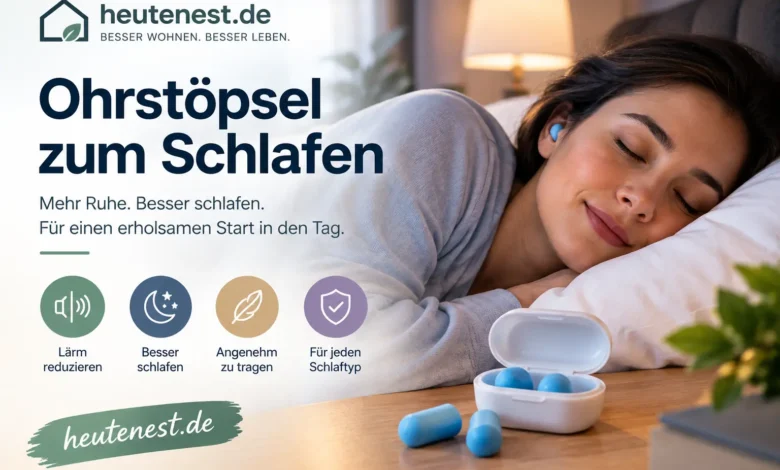
A quiet bedroom can make a major difference when you are trying to fall asleep, stay asleep, or simply get enough rest through the night. Street traffic, a snoring partner, loud neighbours, household sounds, early-morning activity, or working unusual hours can make this difficult. This is where ohrstöpsel zum schlafen can become a practical part of a bedtime routine.
The right ohrstöpsel zum schlafen are not necessarily the ones with the highest advertised noise reduction. Comfort, fit, ear anatomy, material, sleeping position, the type of noise and how long the earplugs are worn all matter. A model that works well for one person may feel uncomfortable or provide little benefit for another.
This guide explains everything from the different types of earplugs and their materials to SNR values, correct insertion, side sleeping, snoring, hygiene, replacement intervals and custom-made solutions. The goal is simple: help you understand what matters before choosing and using earplugs for sleep.
Ohrstöpsel zum Schlafen: Welche Vorteile bieten sie?
Earplugs are designed to reduce the amount of sound reaching the ear. They do not normally create complete silence, and they should not be expected to eliminate every sound in the room. Their purpose is to make unwanted environmental noise less noticeable.
For many sleepers, reducing background noise can make it easier to relax. This can be particularly useful when the problem is a recurring environmental sound rather than a medical sleep disorder.
Typical situations in which earplugs can help
- Snoring from a partner
- Traffic and road noise
- Neighbours in an apartment building
- Voices from other rooms
- Hotel or travel environments
- Daytime sleeping after night shifts
- Household noise
- Occasional loud outdoor sounds
- General background noise
A useful distinction is important: earplugs reduce sound, but they do not guarantee uninterrupted sleep. Their actual performance depends on the product, correct insertion and the individual ear canal.
Independent testing has also shown why comfort matters alongside sound attenuation. Stiftung Warentest assessed earplugs not only for sound reduction but also for wearing comfort after 15 minutes, three hours and overnight sleeping.
Für wen sind Ohrstöpsel zum Schlafen sinnvoll?
Earplugs can be useful for people whose sleep is disturbed by external noise. They can also be helpful in situations where changing the environment is difficult.
For example, someone living beside a busy road cannot simply remove the traffic noise. Similarly, a person sleeping during the day after a night shift may have limited control over normal daytime activity.
They may be worth considering if:
- your bedroom is exposed to regular background noise;
- your partner snores;
- you live in a noisy apartment building;
- you sleep during the day;
- you frequently stay in hotels or unfamiliar environments;
- you are particularly sensitive to environmental sounds.
But there is an important limitation.
If sleep problems continue even when the environment is quiet, earplugs may not address the underlying reason. Persistent insomnia, significant hearing problems, ear pain, discharge or other concerning symptoms should not simply be managed by wearing earplugs every night.
Can earplugs solve every sleep problem? No. They are primarily a sound-reduction tool, not a treatment for every cause of poor sleep.
Welche Arten von Ohrstöpseln gibt es?
The market includes several designs, and the differences are more important than they may initially appear.
The main distinction is between products that sit in front of the ear canal and those that are inserted into the ear canal.
Formable earplugs
Formable silicone or wax products are shaped with the fingers and placed over the entrance of the ear canal rather than pushed deeply inside.
Their main advantage is that they can adapt to the outer ear and may feel comfortable for people who dislike pressure inside the ear canal.
Stiftung Warentest describes these as pre-ear products and notes that they can seal the ear canal from the outside.
Foam earplugs
Foam earplugs are compressed before insertion. Once inside the ear canal, the foam expands and creates a seal.
They are widely available and can provide substantial noise reduction when inserted correctly. However, pressure and fit can become issues for some users.
Reusable plastic or silicone earplugs
Many reusable models use flexible materials, often with lamellae or a cap-shaped design. They can be cleaned and used repeatedly.
They can be practical for regular use, but the shape may not suit every ear. People with narrow or shallow ear canals can sometimes find these designs uncomfortable.
Custom-made earplugs
These are produced according to the individual shape of the ear. They can be particularly interesting for people who repeatedly experience problems with standard sizes.
The higher purchase cost makes them less relevant for occasional use but potentially more interesting for people who rely on ear protection regularly.
Schaumstoff-, Silikon- oder Wachs-Ohrstöpsel: Die wichtigsten Unterschiede
There is no universal material that is automatically best for everyone.
| Material | Main characteristic | Potential advantage | Possible drawback |
|---|---|---|---|
| Foam | Expands inside the ear canal | Strong seal when fitted correctly | Can create pressure or feel intrusive |
| Silicone | Soft and formable | Useful for outer-ear sealing | Fit depends on design and ear shape |
| Wax | Mouldable | Can adapt to the outer ear | Requires careful handling and hygiene |
| Flexible plastic | Often reusable | Durable and washable | Shape may not suit every ear |
| Custom material | Individually fitted | Personalised fit | Higher cost |
The right choice depends on your ear anatomy, sleeping position, sensitivity to pressure and the type of noise you want to reduce.
Is softer always better? Not necessarily. A very soft earplug can feel comfortable but may not provide the seal you need. Conversely, a highly sealing product can reduce sound effectively but become uncomfortable during long periods of use.
Ohrstöpsel für Seitenschläfer
Side sleeping is one of the most important practical considerations when choosing earplugs.
When your head rests on a pillow, the outer ear can be pushed sideways. A bulky earplug may then create additional pressure. This is why a product that feels comfortable while sitting upright may become irritating after several hours in bed.
For side sleepers, look for:
- a low-profile shape;
- soft material;
- minimal protrusion from the ear;
- a stable fit;
- a size that does not create excessive pressure;
- a design that remains comfortable when the ear is pressed against a pillow.
Why do earplugs bother side sleepers more? The pillow can press the outer ear and transfer that pressure toward the earplug. If the plug protrudes too far or sits under tension, discomfort can develop during the night.
The latest practical guidance around custom sleep earplugs also highlights fit, comfort and reliable positioning as important factors for regular sleepers and side sleepers.
Ohrstöpsel gegen Schnarchen und störende Geräusche
Snoring is one of the most common reasons people look for sleep earplugs.
However, snoring is not a single sound. It can vary considerably in volume and frequency. The effectiveness of an earplug therefore depends on both its acoustic properties and how well it seals the ear.
Do earplugs completely block snoring? Usually not. They reduce the sound reaching the ear, but some sound can still be perceived through the ear canal, surrounding structures and normal environmental transmission.
For snoring, consider:
- a comfortable seal for long periods;
- adequate attenuation;
- low pressure;
- a shape suitable for your sleeping position;
- reliable retention throughout the night.
A very high advertised attenuation figure should not automatically determine the purchase. If the product is uncomfortable, poorly fitted or repeatedly falls out, its theoretical performance becomes much less useful in real life.
Ohrstöpsel zum Schlafen bei Straßenlärm und Nachbarn
Different noises behave differently.
Traffic can contain low-frequency engine and road sounds, while voices often contain stronger mid-frequency components. Construction work can contain a mixture of frequencies, including sharp higher-frequency sounds.
This matters because earplug attenuation is not identical across all frequencies.
For apartment living, the most useful question is therefore not simply:
“Which earplug has the highest dB number?”
A better question is:
“Which earplug fits securely and provides suitable attenuation for the type of noise disturbing my sleep?”
For recurring traffic or neighbour noise, a combination of measures can also be more practical than relying on earplugs alone:
- close windows where possible;
- reduce gaps around doors;
- use curtains or other room treatments;
- move the bed away from a shared wall where practical;
- use consistent background sound if appropriate;
- combine environmental noise reduction with comfortable earplugs.
Was bedeutet der SNR-Wert bei Ohrstöpseln?
SNR stands for Single Number Rating. It is a simplified indication of the average sound attenuation provided by hearing protection under specified testing conditions.
The value is expressed in decibels (dB).
For example, an SNR of 30 dB indicates an average attenuation value of 30 dB under the relevant measurement method. It does not mean that every sound in every real-world situation will simply become exactly 30 dB quieter.
Stiftung Warentest explains that the SNR value provides orientation and also distinguishes between H, M and L values for different frequency ranges.
H, M and L values explained
- H refers to higher-frequency sound attenuation.
- M refers to medium-frequency sound attenuation.
- L refers to lower-frequency sound attenuation.
This distinction matters because different noises occupy different frequency ranges.
For example, traffic can contain substantial low- and mid-frequency components, while some other noises have stronger high-frequency components.
Is a higher SNR automatically better? No. A higher rating may indicate greater attenuation under test conditions, but the most suitable product still depends on fit, comfort, frequency characteristics and the user’s actual situation.
Wie viel Lärm können Ohrstöpsel tatsächlich reduzieren?
The real-world result can differ considerably from the number printed on the packaging.
Why?
Because laboratory attenuation and personal attenuation are not exactly the same thing.
The final result depends on:
- the product’s tested attenuation;
- how correctly it is inserted;
- whether the size matches the ear;
- the shape of the ear canal;
- the type and frequency of the noise;
- whether the earplug remains correctly positioned while sleeping.
Stiftung Warentest found significant differences between products when testing sound attenuation and also emphasised that individual ear anatomy affects effectiveness.
This is why two people can use the same pair and report different experiences.
Die richtige Passform für ruhigen und komfortablen Schlaf
Fit is arguably one of the most important parts of choosing earplugs.
Every ear is different. Ear canals can vary in diameter, length and shape, and the left and right ears can even differ from one another. Stiftung Warentest specifically points out these anatomical differences when discussing earplug effectiveness.
A good fit should be:
- secure without excessive pressure;
- comfortable for several hours;
- sufficiently sealed;
- stable when you change sleeping position;
- easy to insert and remove;
- appropriate for your ear size.
Signs that the fit is wrong
An earplug may be too large if you experience:
- persistent pressure;
- pain;
- a strong foreign-body sensation;
- soreness after removing it.
It may be too small or poorly shaped if:
- it repeatedly falls out;
- external noise remains almost unchanged;
- you constantly need to reposition it;
- it does not create a stable seal.
What if the two ears are different sizes? That is completely possible. If one side feels comfortable while the other does not, separate sizes or a different design may be necessary.
Ohrstöpsel richtig einsetzen
Correct insertion is essential, particularly with foam earplugs.
For a typical foam model:
- Wash and dry your hands.
- Roll or compress the foam according to the manufacturer’s instructions.
- Gently pull the outer ear upward and slightly backward if the product instructions recommend this.
- Insert the compressed plug carefully without forcing it.
- Hold it in position long enough for the foam to expand.
- Check whether it feels secure and comfortable.
- Repeat the process on the other ear.
Do not push an earplug farther into the ear simply because you want more noise reduction.
For mouldable silicone or wax products, the procedure is different because they generally sit over the entrance of the ear canal rather than being pushed deep inside.
Always follow the product’s own instructions because designs differ.
Warum fallen Ohrstöpsel beim Schlafen heraus?
An earplug can fall out for several reasons.
Common causes
- The size is too small.
- The ear canal is relatively wide.
- The material does not maintain its shape.
- The plug was not inserted correctly.
- The earplug is pushed out when changing sleeping position.
- Earwax prevents a stable seal.
- The design is simply incompatible with the person’s ear.
If an earplug repeatedly falls out, buying a model with a higher advertised SNR is not necessarily the solution.
First check fit, size, insertion and shape.
Warum drücken Ohrstöpsel im Ohr?
Pressure can come from the material, the dimensions or the way the earplug sits inside the ear.
Foam models expand after insertion, which can create a noticeable pressure sensation for some people. Reusable in-ear designs can also feel uncomfortable if the ear canal is narrow or shallow.
A plug that hurts should not simply be tolerated in the hope that your ear will “get used to it”.
Try:
- a smaller size;
- a softer design;
- a different material;
- a lower-profile model;
- an outer-ear design;
- or professional fitting if standard products consistently cause problems.
When should you stop using an earplug? Stop using it if it causes significant pain, persistent irritation, bleeding, discharge or other unusual symptoms, and seek appropriate medical advice.
Ohrstöpsel zum Schlafen und der Wecker: Kann man ihn noch hören?
This is one of the most practical questions people have.
The answer is: it depends.
Earplugs reduce environmental sound, so they may also reduce the sound of an alarm clock. Whether you still hear the alarm depends on its volume, frequency, distance and the amount of attenuation provided by the earplugs.
If waking on time is essential, consider an additional alert method rather than relying solely on an audible alarm.
Possible options include:
- a vibrating smartwatch;
- a vibrating alarm device;
- a phone placed close enough to provide a strong alert;
- a combination of vibration and sound.
Can you sleep safely with earplugs if you need to hear an emergency alarm? You should not assume that you will hear every alarm while wearing them. If an alarm is safety-critical, use an appropriate secondary alert system.
Sind Ohrstöpsel für die tägliche Nutzung geeignet?
Daily use can be possible, but the answer depends on the product, hygiene and the condition of your ears.
Not every earplug is designed for indefinite repeated use. Some products are intended for single or limited use, while reusable models are specifically designed to be cleaned and used repeatedly.
Stiftung Warentest’s product testing considered factors such as reusability, service life and hygiene information on packaging and instructions.
For regular use:
- choose a product intended for your usage pattern;
- keep reusable models clean;
- do not continue using damaged earplugs;
- avoid sharing earplugs;
- keep your ears dry and clean;
- monitor irritation or discomfort.
Daily use is also not a reason to ignore recurring ear problems.
Reinigung und Hygiene von Ohrstöpseln
Earplugs come into contact with skin, earwax and moisture. Reusable models therefore need appropriate cleaning.
The exact cleaning method depends on the material.
For reusable earplugs
Follow the manufacturer’s instructions. In many cases, washable silicone or plastic earplugs can be cleaned with suitable water and mild cleaning methods before being thoroughly dried.
Avoid aggressive chemicals unless the manufacturer specifically says they are safe.
For foam earplugs
Disposable foam products should not be treated as if they were durable reusable silicone products. Foam can collect earwax and dirt and may lose its original properties.
Stiftung Warentest notes that foam earplugs can become contaminated with earwax and that their material can harden over time.
Hygiene rules that matter
- Wash your hands before handling earplugs.
- Keep reusable earplugs clean.
- Allow them to dry properly.
- Do not share them with another person.
- Replace products when they become dirty, damaged or unsuitable for continued use.
Lesen Sie unseren aktuellen und genauen Ratgeber zum Thema YSL Tasche.
Wie oft sollte man Ohrstöpsel wechseln?
There is no single replacement interval that applies to every type.
The correct timing depends on:
- material;
- whether the product is disposable or reusable;
- manufacturer instructions;
- visible dirt;
- damage;
- loss of shape;
- reduced performance;
- hygiene.
Some reusable products can remain usable for a long time when properly maintained, while disposable products should be replaced according to their intended use.
For example, Stiftung Warentest distinguishes between products marketed as reusable and those not intended for repeated use.
Should you replace an earplug simply because it has been used once? Not necessarily. The product’s intended reuse instructions matter. A disposable model and a properly designed reusable model should not be treated the same way.
Einweg oder wiederverwendbar: Was ist besser?
The choice depends on how often you use earplugs.
Disposable earplugs
They can be convenient for:
- occasional travel;
- short-term noise exposure;
- situations where quick replacement is practical;
- users who prefer not to clean earplugs.
Their disadvantage is that frequent use creates ongoing replacement needs.
Reusable earplugs
They can be useful for:
- regular sleepers;
- frequent travellers;
- people who use earplugs several nights per week;
- users who prefer a washable product.
Their advantage is long-term usability when properly maintained.
However, reusable does not mean “use forever”. Damage, contamination, loss of shape and hygiene problems remain reasons for replacement.
Maßgefertigte Ohrstöpsel: Wann lohnt sich die individuelle Anpassung?
Custom-made earplugs are created around an individual’s ear shape rather than relying on a universal size.
They can be worth considering when standard products repeatedly cause problems such as:
- pressure;
- pain;
- poor retention;
- inconsistent sealing;
- discomfort while sleeping on the side;
- difficulty finding a suitable size.
They can also be relevant for people who use ear protection frequently, such as shift workers or people who regularly sleep during the day.
A 2026 quality-testing article on custom sleep earplugs similarly highlights fit, comfort and personal application as key factors, rather than simply chasing the maximum possible attenuation figure.
The main disadvantage is cost. Custom solutions are generally more expensive than standard products.
Ohrstöpsel zum Schlafen kaufen: Darauf kommt es 2026 an
Buying based only on brand name or the highest decibel figure is a weak selection method.
Instead, evaluate the product using several criteria.
1. Fit
Does the shape suit your ear canal and outer ear?
2. Sleeping position
If you sleep on your side, check whether the product protrudes or creates pressure.
3. Material
Think about whether foam, silicone, wax or flexible plastic feels appropriate for your ears.
4. Sound attenuation
Look at the available attenuation information, including SNR and, where provided, H, M and L values.
5. Comfort
A product intended for overnight use needs to remain comfortable for several hours.
6. Reusability
Choose according to how frequently you intend to use the product.
7. Hygiene
Check how the product should be cleaned and how long it is intended to remain usable.
8. Product information
Look for clear information about intended use, fitting, attenuation, reuse, lifespan and hygiene.
Stiftung Warentest included these kinds of product-information criteria in its assessment, alongside sound attenuation, comfort, handling and potentially harmful substances.
9. Your actual noise problem
A product designed primarily around comfort may be more useful for one sleeper, while someone dealing with substantial environmental noise may place greater importance on attenuation.
The important point is to match the earplug to the problem, not simply to a marketing claim.
Welcher Ohrstöpsel passt zu welchem Schlafproblem?
There is no single design that suits every sleeping situation.
| Sleep problem | What to prioritise |
|---|---|
| Snoring partner | Comfortable seal and suitable attenuation |
| Side sleeping | Low-profile shape and low pressure |
| Traffic noise | Suitable attenuation across relevant frequencies |
| Loud neighbours | Stable fit and good overall attenuation |
| Daytime sleeping | Comfortable long-duration wear |
| Travel | Compact and easy-to-use design |
| Small ear canals | Appropriate size and low pressure |
| Frequent use | Reusability and easy cleaning |
| Repeated fit problems | Consider professional/custom fitting |
What is the best starting point? Identify the sound that wakes you, your sleeping position and how frequently you need earplugs. Those three factors narrow the options much more effectively than choosing by advertising alone.
Häufige Fehler bei der Verwendung von Ohrstöpseln
Even a good product can perform poorly when it is used incorrectly.
Fehler 1: Nur nach dem höchsten SNR-Wert auswählen
A high attenuation rating does not automatically mean better comfort or better real-world results.
Fehler 2: Zu tief einsetzen
Earplugs should never be forced deeply into the ear. Correct placement depends on the design.
Fehler 3: Schmerzen ignorieren
Pain is not a sign that the earplug is “working better”.
Fehler 4: Größe und Passform übersehen
A poor fit can reduce both comfort and practical sound reduction.
Fehler 5: Einwegprodukte dauerhaft verwenden
Disposable products should not automatically be treated as reusable products.
Fehler 6: Wiederverwendbare Modelle nicht reinigen
Dirt, earwax and moisture can accumulate over time.
Fehler 7: Nur die Ohrstöpsel für ein großes Lärmproblem einsetzen
Room-level noise reduction can sometimes make a significant difference alongside earplugs.
Fehler 8: Den Wecker nicht berücksichtigen
If waking at a particular time is essential, test your alarm setup before relying on earplugs overnight.
Fehler 9: Jedes Ohr gleich behandeln
The left and right ear can have different shapes. A product that fits one side perfectly may not feel identical on the other.
Häufig gestellte Fragen
Welche Ohrstöpsel sind zum Schlafen am bequemsten?
Comfort depends strongly on ear anatomy and sleeping position. Soft, low-profile designs can be useful for side sleepers, while some people prefer formable products that sit around the entrance of the ear canal.
Welche Ohrstöpsel sind für Seitenschläfer geeignet?
Side sleepers should generally pay particular attention to low-profile construction, softness and pressure. A bulky plug can become uncomfortable when the outer ear presses against the pillow.
Helfen Ohrstöpsel gegen Schnarchen?
They can reduce the amount of snoring sound reaching the ear, but they usually do not eliminate it completely. Fit, seal and the acoustic characteristics of the product all affect the result.
Was bedeutet SNR bei Ohrstöpseln?
SNR means Single Number Rating. It provides a simplified indication of average sound attenuation under standardised testing conditions. It should be treated as an orientation value rather than a guarantee of identical real-world attenuation.
Sind Ohrstöpsel mit einem höheren SNR immer besser?
No. Higher attenuation can be useful in some situations, but comfort, fit, frequency-specific attenuation and intended use also matter.
Kann man mit Ohrstöpseln den Wecker hören?
Possibly, but it cannot be guaranteed. Because earplugs reduce sound, they may also make an alarm quieter. A vibrating alarm can provide an additional alert.
Kann man Ohrstöpsel jede Nacht tragen?
Some products are designed for regular use, but daily wear requires appropriate hygiene and attention to comfort. The manufacturer’s instructions for reuse and cleaning should be followed.
Wie oft müssen Ohrstöpsel gewechselt werden?
It depends on the material and product design. Disposable models have different requirements from reusable products. Damaged, dirty or deteriorated earplugs should be replaced.
Sind Schaumstoff-Ohrstöpsel wiederverwendbar?
Some products may be marketed for limited reuse, but foam should not automatically be treated like a washable reusable material. Follow the manufacturer’s instructions and replace the product when it becomes dirty, damaged or loses its intended properties.
Sind Silikon-Ohrstöpsel besser als Schaumstoff?
Neither material is universally better. Silicone may suit people who prefer an outer-ear seal, while foam can provide a strong in-ear seal when correctly fitted. Personal comfort and ear anatomy are decisive.
Warum fallen meine Ohrstöpsel nachts heraus?
Common causes include an unsuitable size, poor insertion, an incompatible shape, earwax or movement during sleep. Trying a different size or design may solve the problem.
Warum tun Ohrstöpsel im Ohr weh?
Pressure can result from the wrong size, material, shape or insertion. Persistent pain should not be ignored.
Können Ohrstöpsel das Gehör schädigen?
Correct use of suitable earplugs is different from forcing objects deep into the ear. Problems can arise from inappropriate insertion, poor hygiene or continued use despite pain and irritation. If you experience persistent ear symptoms, professional medical advice is appropriate.
Welche Ohrstöpsel eignen sich bei kleinen Gehörgängen?
Look for products available in different sizes or designs that place less pressure inside the canal. If standard models repeatedly cause discomfort, individual fitting may be worth discussing with an appropriate professional.
Lohnt sich ein maßgefertigter Gehörschutz zum Schlafen?
It can be worth considering for people who use earplugs frequently and cannot achieve reliable comfort or fit with standard products. The additional cost is the main consideration.
Fazit
Choosing the right earplugs for sleep is less about finding a universally “best” product and more about finding the right combination of fit, comfort, attenuation, material and intended use.
A side sleeper may need a different design from someone sleeping on their back. A person disturbed by a snoring partner has a different noise problem from someone living beside a busy road. Likewise, someone using earplugs every night has different requirements from someone who only needs them during occasional travel.
Start by identifying the noise you want to reduce, consider your sleeping position, choose a suitable material and size, and pay attention to the manufacturer’s information about attenuation, cleaning and reuse. If standard earplugs repeatedly cause pressure, pain or poor retention, an individually fitted solution may be worth considering.
The most useful earplug is ultimately the one that provides meaningful noise reduction without becoming another reason to wake up during the night.
Lesen Sie unseren aktuellen und genauen Ratgeber zum Thema ferien niedersachsen.